📚 Series Navigation:
← Previous: Part 7 - Real-World Case Study
👉 You are here: Part 8 - Modern QA Workflow
Next: Part 9 - Bug Reports That Get Fixed →
Introduction: QA in the Age of Agile and DevOps
Welcome to Part 8! We've learned powerful testing techniques and seen them applied in a real case study. But here's a question that keeps QA engineers up at night:
"How do I actually DO all this in a 2-week sprint?"
The reality of modern software development:
- ⚡ Deploys happen daily (or hourly!)
- 🔄 Requirements change mid-sprint
- 🤝 Testing happens in parallel with development
- 🤖 CI/CD pipelines run on every commit
- 📱 Multiple platforms, browsers, devices
- ⏰ "We need this tested by tomorrow"
Gone are the days when QA was a separate phase at the end. Today, quality is everyone's responsibility, and testing is continuous.
In this article, you'll learn:
- ✅ How testing fits into modern Agile workflows
- ✅ Shift-left testing in practice (not just theory)
- ✅ Building effective CI/CD pipelines
- ✅ Risk-based test prioritization for tight deadlines
- ✅ Collaboration patterns that actually work
- ✅ The Three Amigos and other ceremonies
Let's make modern QA actually work! 🚀
🔄 The Modern Agile QA Workflow
The Traditional Waterfall Approach (What We Left Behind)
Requirements → Design → Development → QA Testing → Release
                                      ↑
                            [QA enters here, finds 100 bugs,
                             everyone blames QA, project delayed]
Problems:
- ❌ Testing happens too late
- ❌ Bugs are expensive to fix
- ❌ QA becomes a bottleneck
- ❌ No collaboration during development
- ❌ Requirements already stale by testing time
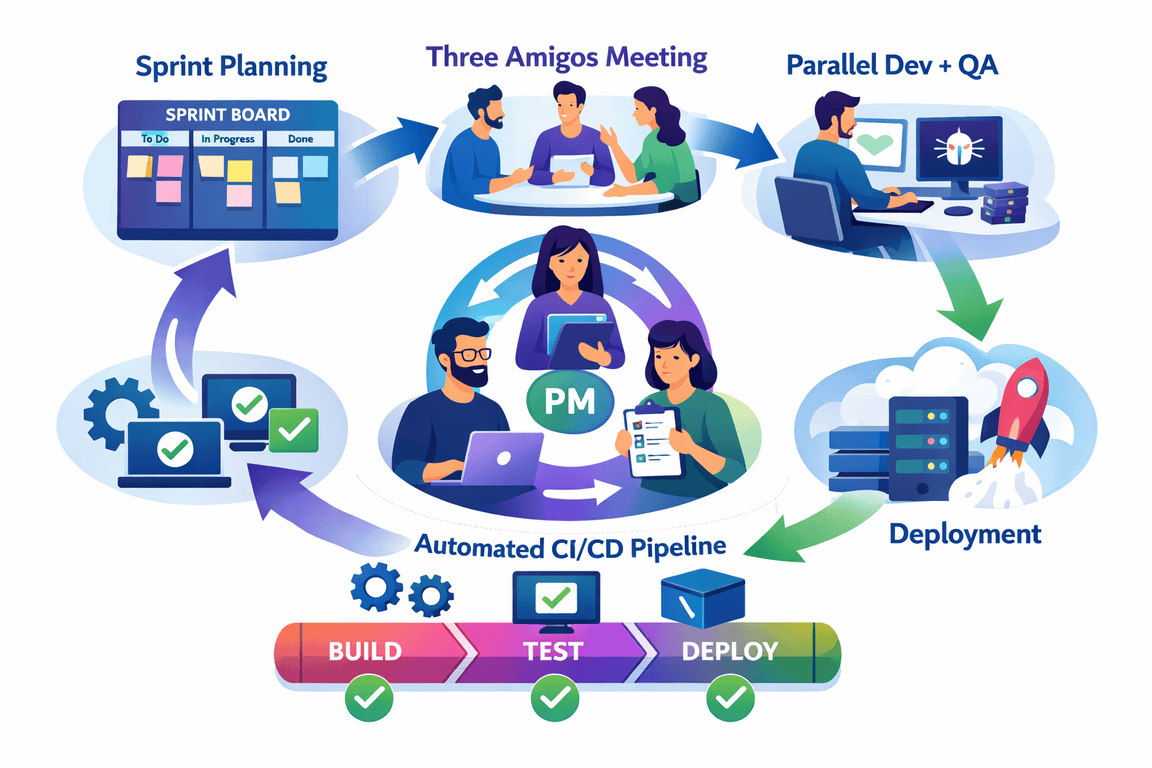
The Modern Agile Approach (Where We Are Now)
QA Present] --> B[Three Amigos
Early Clarification] B --> C[Dev + QA
Parallel Work] C --> D[Continuous Testing
Every Commit] D --> E[Sprint Review
Demo + Retro] E --> F{Done?} F -->|Yes| G[Deploy to Prod] F -->|No| C style A fill:#dbeafe style B fill:#fef3c7 style C fill:#ddd6fe style D fill:#bbf7d0 style E fill:#fecaca style G fill:#86efac
What's Different:
- ✅ QA involved from day 1
- ✅ Testing starts before code is written
- ✅ Continuous feedback loops
- ✅ Everyone owns quality
- ✅ Fast iterations
A Week in the Life of a Modern QA Engineer
Monday (Sprint Planning Day)
9:00 AM - Sprint Planning Meeting
├─ QA reviews user stories
├─ Asks clarifying questions
├─ Estimates testing effort
├─ Identifies risks
└─ Commits to sprint capacity

11:00 AM - Story Refinement
├─ Deep dive on 2-3 complex stories
├─ QA identifies testability issues
├─ Team discusses acceptance criteria
└─ QA flags dependencies

2:00 PM - Test Planning
├─ Create high-level test scenarios
├─ Identify automation candidates
├─ Plan test data needs
└─ Update risk matrix
Tuesday-Wednesday (Early Sprint)
9:00 AM - Three Amigos Sessions
├─ Developer + PM + QA
├─ Walk through user story
├─ Clarify edge cases
└─ Define acceptance criteria

10:00 AM - Test Case Design
├─ Write detailed test cases for story starting tomorrow
├─ Prepare test automation scripts
└─ Set up test environments

2:00 PM - Early Testing
├─ Test stories marked "ready for testing"
├─ Pair with developers on unit tests
├─ Review code for testability
└─ Provide quick feedback
Thursday-Friday (Mid-Late Sprint)
9:00 AM - Test Execution
├─ Execute test cases on completed stories
├─ Run automated regression suite
├─ Exploratory testing on new features
└─ Log bugs, verify fixes

1:00 PM - Bug Triage
├─ Review bugs with dev team
├─ Prioritize fixes
├─ Verify bug fixes
└─ Update test cases

4:00 PM - Sprint Preparation
├─ Update documentation
├─ Prepare demo scenarios
├─ Sign off completed stories
└─ Identify technical debt
Key Differences from Traditional:
- QA isn't waiting for "QA phase"
- Testing happens in parallel with dev
- Continuous communication
- Faster feedback loops
⬅️ Shift-Left Testing: Moving Quality Earlier
What is Shift-Left?
Traditional Approach:
Dev → Dev → Dev → Testing → Production
                    ↑
              [Find bugs here]
              [Expensive to fix!]
Shift-Left Approach:
Testing → Dev + Testing → Testing → Production
   ↑            ↑            ↑
[Design]    [Implementation] [Verification]
[Cheap]       [Moderate]      [Expensive]
The principle: The earlier you find defects, the cheaper they are to fix.
Cost of defects:
- 💰 Found during requirements: $1
- 💰💰 Found during development: $10
- 💰💰💰 Found during QA: $100
- 💰💰💰💰 Found in production: $1,000+
Shift-Left in Practice
1. Requirements Review (Day 0)
Traditional QA: "We'll test it when it's done."
Shift-Left QA:
Story Received: "User can export tasks"

QA Questions (Before Any Code):
❓ What formats? (CSV, Excel, PDF?)
❓ All tasks or filtered tasks?
❓ Include completed tasks?
❓ File size limits?
❓ Email or download?
❓ What if export fails?

Result: 6 ambiguities caught before a single line of code written!
Action Items:
- ✅ Review every user story before sprint starts
- ✅ Add testability acceptance criteria
- ✅ Identify missing scenarios
- ✅ Flag technical risks
2. Unit Test Collaboration (Day 1-3)
Traditional QA: "Unit tests are the developer's job."
Shift-Left QA:
QA + Developer Pair Programming Session:

Developer: "I'm writing validateEmail() function"
QA: "Great! Let's think about test cases:
     - Valid emails (with +, with subdomain)
     - Invalid emails (missing @, missing domain)
     - Null, empty string
     - SQL injection attempts
     - 320-character email (max length)"

Result: Developer writes comprehensive unit tests,
        QA provides edge cases developers might miss
Action Items:
- ✅ Pair with developers on unit tests
- ✅ Review test coverage reports
- ✅ Suggest missing test cases
- ✅ Share testing expertise
3. API Testing (Day 2-4)
Traditional QA: "Wait for UI to be done, then test through UI."
Shift-Left QA:
API Ready → QA Tests API Directly
├─ Faster feedback
├─ Backend bugs found immediately
├─ UI can be built in parallel
└─ API tests become regression suite

Example:
POST /api/tasks
{
  "title": "Test Task",
  "description": "<script>alert('xss')</script>"
}

Response: 400 Bad Request
{"error": "Invalid characters in description"}

✅ XSS protection verified before UI exists!
Action Items:
- ✅ Test APIs as soon as endpoints exist
- ✅ Use Postman/Insomnia/REST Assured
- ✅ Automate API tests early
- ✅ Don't wait for UI
4. Test Automation (Day 1-5)
Traditional QA: "Automate after manual testing proves it works."
Shift-Left QA:
Write automation scripts WHILE features are being developed:

Day 1: Feature branch created → Create test skeleton
Day 2: API ready → Automate API tests
Day 3: UI component ready → Automate happy path
Day 4: Feature complete → Add negative tests
Day 5: Ready for merge → Full automation suite ready

Result: Automation available immediately for regression!
Action Items:
- ✅ Automate in parallel with development
- ✅ Start with API-level tests
- ✅ Add UI tests incrementally
- ✅ Make automation part of Definition of Done
🤖 CI/CD Integration: Testing at the Speed of DevOps
The CI/CD Pipeline for QA
10 sec] C --> D{Pass?} D -->|No| E[❌ Notify Developer] D -->|Yes| F[Integration Tests
3 min] F --> G{Pass?} G -->|No| E G -->|Yes| H[Deploy to Dev] H --> I[Smoke Tests
5 min] I --> J{Pass?} J -->|No| E J -->|Yes| K[E2E Tests
20 min] K --> L{Pass?} L -->|No| E L -->|Yes| M[Deploy to Staging] M --> N[Manual Acceptance
As needed] N --> O[✅ Deploy to Production] style A fill:#dbeafe style C fill:#86efac style F fill:#fbbf24 style I fill:#fbbf24 style K fill:#f87171 style O fill:#4ade80
Pipeline Design Principles
1. Fast Feedback
Goal: Developer knows within 5 minutes if they broke something

Pipeline Strategy:
├─ Unit tests: Must run in < 1 minute
├─ Integration tests: Must run in < 5 minutes
├─ E2E tests: Can run in background (20-30 min)
└─ Full suite: Nightly or pre-release only

Example - TaskMaster 3000:
├─ Commit → Unit tests (15 sec) ✅
├─ → Integration tests (3 min) ✅
├─ → Deploy to dev (30 sec) ✅
├─ → Smoke tests (2 min) ✅
└─ Total time to dev environment: < 7 minutes
2. Fail Fast
Run cheapest/fastest tests first:
1. Linting & static analysis (seconds)
2. Unit tests (seconds-minutes)
3. Integration tests (minutes)
4. E2E tests (minutes-hours)

Don't run expensive tests if cheap ones fail!
3. Parallel Execution
Instead of: Test 1 → Test 2 → Test 3 (30 min total)
Do: Test 1 ║ Test 2 ║ Test 3 (10 min total)

Tools:
- Selenium Grid (parallel browser tests)
- Jenkins: Parallel stages
- GitHub Actions: Matrix builds
- CircleCI: Parallelism option
4. Environment Management
Problem: "Works on my machine!" 🤷

Solution: Containerization
├─ Docker for consistent environments
├─ Docker Compose for multi-service setups
├─ Kubernetes for production-like staging
└─ Infrastructure as Code (Terraform)

Example docker-compose.yml:
version: '3'
services:
  app:
    build: .
    environment:
      - NODE_ENV=test
  db:
    image: postgres:14
  redis:
    image: redis:7
Test Types in CI/CD
Commit Stage (Every commit, < 5 min)
✅ Linting (ESLint, Pylint)
✅ Unit tests (900 tests, 15 sec)
✅ Code coverage check (> 70%)
✅ Security scan (npm audit, Snyk)
Acceptance Stage (Every PR, < 15 min)
✅ Integration tests (450 tests, 8 min)
✅ API contract tests (Pact)
✅ Component tests
✅ Build Docker image
Deployment Stage (After merge, < 30 min)
✅ Deploy to dev environment
✅ Smoke tests (20 critical paths)
✅ E2E tests (120 tests, 20 min)
✅ Performance tests (basic)
Release Stage (Scheduled/on-demand)
✅ Full regression suite
✅ Load testing
✅ Security penetration tests
✅ Cross-browser tests (BrowserStack)
✅ Accessibility tests
⚖️ Risk-Based Test Prioritization
The Harsh Reality
Manager: "We deploy in 2 hours. Can you test everything?"
QA: "No, but I can test what matters!"
This is where risk-based testing saves you.
Risk Assessment Matrix
| Feature | Biz | User | Comp | Change | Risk | Test |
|---|---|---|---|---|---|---|
| Auth | 5C | 5A | 3M | 1S | 🔴14/20 | 1 - Full |
| Task Remind | 4H | 4M | 4C | 5N | 🔴17/20 | 1 - Full |
| Task Export | 2L | 3S | 2S | 1S | 🟢8/20 | 3 - Smoke |
| Theme Select | 1M | 2P | 1S | 1S | 🟢5/20 | 4 - Skip |
Legend
Biz (Business Impact): 5C=Critical 🔴, 4H=High 🔴, 2L=Low 🟢, 1M=Minimal 🟢
User: 5A=All, 4M=Many, 3S=Some, 2P=Preference
Comp (Complexity): 1S=Simple, 3M=Moderate, 4C=Complex
Change (Change Freq): 1S=Stable, 5N=New
Risk: 🔴=High, 🟢=Low
Test (Testing Priority): 1=Full, 3=Smoke, 4=Skip
The 2-Hour Emergency Test Plan
Scenario: Critical hotfix needs to deploy in 2 hours. What do you test?
EMERGENCY TESTING PROTOCOL - 2 HOUR LIMIT

Hour 1: Critical Paths (80% of value)
├─ [15 min] Authentication flow
│   └─ Login, logout, session management
├─ [15 min] Core task operations
│   └─ Create, edit, complete, delete tasks
├─ [15 min] Data integrity
│   └─ No data loss, corruption, or leaks
├─ [10 min] Payment (if applicable)
│   └─ Checkout, payment processing
└─ [5 min] Smoke test in production-like environment

Hour 2: Risk Areas (15% of value)
├─ [20 min] Areas changed by hotfix
│   └─ Thorough testing of modified code
├─ [15 min] Integration points
│   └─ External APIs, database, email
├─ [10 min] Security basics
│   └─ SQL injection, XSS, auth bypass
├─ [10 min] Error handling
│   └─ Graceful degradation
└─ [5 min] Final sanity check

Skipped (5% of value):
❌ Nice-to-have features
❌ Cosmetic UI elements
❌ Rarely-used functionality
❌ Comprehensive browser testing

Document what was NOT tested!
Risk-Based Test Selection Algorithm
def prioritize_tests(tests, time_available_minutes):
    """
    Prioritize tests based on risk and time
    """
    for test in tests:
        test.score = (
            test.business_impact * 5 +
            test.user_impact * 4 +
            test.defect_history * 3 +
            test.code_complexity * 2 +
            test.change_frequency * 3
        )

    tests.sort(key=lambda t: t.score, reverse=True)

    selected_tests = []
    time_used = 0

    for test in tests:
        if time_used + test.execution_time <= time_available_minutes:
            selected_tests.append(test)
            time_used += test.execution_time
        else:
            break

    return selected_tests, tests[len(selected_tests):]
🤝 Effective Collaboration Patterns
The Three Amigos Meeting
Who: Developer + Product Owner + QA
When: Before development starts
Duration: 30-60 minutes per story
Goal: Shared understanding
Agenda:
1. PO Explains the "Why" (5 min)
   ├─ Business value
   ├─ User problem being solved
   └─ Success criteria

2. Developer Explains the "How" (10 min)
   ├─ Technical approach
   ├─ Dependencies
   ├─ Risks
   └─ Time estimate

3. QA Explains the "What If" (15 min)
   ├─ Edge cases
   ├─ Error scenarios
   ├─ Testability concerns
   ├─ Non-functional requirements
   └─ Test strategy

4. Together: Refine Acceptance Criteria (15 min)
   ├─ What does "done" look like?
   ├─ What are we NOT building?
   ├─ What can break?
   └─ How will we test it?

5. Agreements & Actions (5 min)
   ├─ Final acceptance criteria
   ├─ Definition of Done
   ├─ When testing can start
   └─ Who does what
Example Three Amigos Output:
STORY: Export Tasks to CSV

BEFORE Three Amigos:
"User can export tasks to CSV"

AFTER Three Amigos:
✅ Export filtered tasks (respects current filters)
✅ Include: title, description, status, priority, due date
✅ Format: CSV with UTF-8 encoding
✅ File naming: tasks_export_YYYY-MM-DD_HH-MM.csv
✅ Max 10,000 tasks per export
✅ Download in browser (not email)
✅ Error handling: Show error if > 10,000 tasks
✅ Tested: Chrome, Firefox, Safari
✅ Performance: Should complete in < 3 seconds

Questions Resolved:
Q: Include completed tasks? A: Yes, if they're in current filter
Q: Excel support? A: Future story, CSV only for now
Q: Email option? A: Future story
Q: Column order? A: Title, Status, Priority, Due Date, Description

Definition of Done:
□ Feature implemented
□ Unit tests written (>80% coverage)
□ API tests automated
□ Manual testing completed
□ Works in Chrome, Firefox, Safari
□ Documentation updated
□ PO sign-off received
Daily Stand-ups (QA Perspective)
Bad Stand-up:
QA: "Yesterday I tested stuff. Today I'll test more stuff. No blockers."Good Stand-up:
QA: "Yesterday I tested the reminder feature - found 3 bugs,
     2 are high priority (shared in Slack #bugs channel).

     Today I'm finishing reminder testing and starting on
     the export feature once the API is ready.

     Blocker: I need the staging environment fixed - it's been
     down since yesterday afternoon. Mike, can we sync after
     standup?"
QA-Specific Updates to Share:
- Test coverage status
- Critical bugs found
- Blocked test scenarios
- Release readiness status
Bug Triage Sessions
When: 2-3 times per week, 30 minutes
Who: Dev Lead + QA Lead + PM
Process:
For each bug:

1. Verify reproducibility (2 min)
   ├─ Can we reproduce it?
   └─ Is it actually a bug?

2. Assess severity (2 min)
   ├─ How many users affected?
   ├─ Workaround available?
   └─ Data loss risk?

3. Decide priority (1 min)
   ├─ Fix now (critical)
   ├─ Fix this sprint (high)
   ├─ Backlog (medium/low)
   └─ Won't fix (not a bug, by design)

4. Assign owner (1 min)

Total: ~6 min per bug
10 bugs = 60 minutes session
Priority Framework:
🔴 P0 - Critical (Fix immediately, all hands on deck)
├─ Production down
├─ Data loss/corruption
├─ Security vulnerability
└─ Payment processing broken

🟡 P1 - High (Fix this sprint)
├─ Major feature broken
├─ Affects many users
├─ No workaround
└─ Blocks other work

🟢 P2 - Medium (Next sprint)
├─ Minor feature broken
├─ Affects some users
├─ Workaround exists
└─ Cosmetic issues

🔵 P3 - Low (Backlog)
├─ Edge cases
├─ Rare scenarios
├─ Polish items
└─ Nice-to-have

⚪ P4 - Won't Fix
├─ By design
├─ Out of scope
├─ Not reproducible
└─ Obsolete
📊 Modern QA Metrics & Dashboards
Metrics That Matter in Agile
Sprint Health Dashboard:
📊 Sprint 24 - Week 2

VELOCITY & CAPACITY
└─ Story Points Committed: 45
└─ Story Points Tested: 38 (84%)
└─ Story Points Done: 35 (78%)
└─ At Risk: 2 stories (not tested yet)

TEST EXECUTION
└─ Manual Tests: 85% complete (120/141)
└─ Automated Tests: Running in CI (234/234 passing)
└─ Exploratory Sessions: 2/3 complete

DEFECTS
└─ Opened This Sprint: 12
└─ Fixed This Sprint: 10
└─ Still Open: 5 (2 critical, 3 medium)
└─ Escaped from Last Sprint: 1

AUTOMATION
└─ New Tests Automated: 8
└─ Flaky Tests Fixed: 2
└─ Coverage Trend: 72% → 75% ↗️

RELEASE READINESS: 🟡 YELLOW
✅ All critical bugs fixed
⚠️ 2 stories still in testing
⚠️ 1 high-priority bug open
Leading vs Lagging Indicators
Lagging Indicators (Rearview Mirror):
- Bugs found in production
- Test coverage percentage
- Number of test cases
Leading Indicators (Windshield):
- Shift-left activities (requirements review, three amigos)
- Automated test growth rate
- Time to detect bugs (MTTD)
- % of stories with acceptance tests before coding
Focus on leading indicators to prevent problems!
🎓 Conclusion: QA in the Fast Lane
Modern QA isn't about being a gatekeeper at the end of development. It's about being a quality advocate throughout the entire process.
Key Takeaways
- Shift left aggressively - Get involved early, catch issues when they're cheap to fix
- Automate strategically - Fast feedback loops in CI/CD, pyramid-shaped test suite
- Prioritize ruthlessly - You can't test everything, so test what matters most
- Collaborate continuously - Three Amigos, pairing, daily communication
- Measure what helps - Leading indicators predict quality, lagging indicators confirm it
Your Modern QA Checklist
Sprint Planning:
□ Review all stories before sprint starts
□ Estimate testing effort honestly
□ Identify risks and dependencies
□ Plan Three Amigos sessions
□ Block time for automation
During Sprint:
□ Three Amigos for each story
□ Start testing as soon as possible
□ Provide fast feedback to developers
□ Automate while developing
□ Update automation in CI/CD
Sprint Review:
□ Demo tested features
□ Report on quality metrics
□ Discuss escaped defects
□ Share lessons learned
□ Plan next sprint improvements
The Modern QA Mindset
Old mindset: "Find all the bugs before release"
New mindset: "Help the team build quality in from the start"
Old mindset: "QA is responsible for quality"
New mindset: "Everyone is responsible for quality, QA enables it"
Old mindset: "Manual testing is QA's job"
New mindset: "Automation enables strategic manual testing"
Old mindset: "We're a bottleneck, development waits for us"
New mindset: "We work in parallel, enabling faster delivery"
What's Next?
In Part 9, we'll tackle one of the most important QA skills: Writing Bug Reports That Actually Get Fixed.
We'll cover:
- The anatomy of a great bug report
- How to communicate with developers effectively
- Prioritizing and triaging bugs
- Following up without being annoying
- Building trust with the development team
Coming Next Week:
Part 9: Bug Reports That Get Fixed - The Art of Communication 🐛
📚 Series Progress
✅ Part 1: Requirement Analysis
✅ Part 2: Equivalence Partitioning & BVA
✅ Part 3: Decision Tables & State Transitions
✅ Part 4: Pairwise Testing
✅ Part 5: Error Guessing & Exploratory Testing
✅ Part 6: Test Coverage Metrics
✅ Part 7: Real-World Case Study
✅ Part 8: Modern QA Workflow ← You just finished this!
⬜ Part 9: Bug Reports That Get Fixed
⬜ Part 10: The QA Survival Kit
🧮 Quick Reference Card
Daily QA Workflow
MORNING:
□ Check CI/CD pipeline status
□ Review overnight test results
□ Attend daily standup
□ Respond to bug assignments

MIDDAY:
□ Test completed stories
□ Pair with developers on new stories
□ Write/update test automation
□ Three Amigos sessions

AFTERNOON:
□ Exploratory testing
□ Update test documentation
□ Bug triage/verification
□ Plan tomorrow's work

BEFORE LEAVING:
□ Update story status in Jira
□ Document blockers
□ Check CI/CD still green
□ Tomorrow's prep
Three Amigos Template
STORY: [Story title]
DATE: [Date]
ATTENDEES: [Dev, PO, QA]

BUSINESS VALUE:
[Why are we building this?]

TECHNICAL APPROACH:
[How will we build it?]

EDGE CASES & RISKS:
[What could go wrong?]

ACCEPTANCE CRITERIA:
[What does done look like?]

DEFINITION OF DONE:
□ [Checklist items]

QUESTIONS RESOLVED:
Q: [Question]
A: [Answer]

ACTIONS:
□ [Who does what]
Remember: Quality is a team sport. Be the teammate that makes everyone better! 🎯
What's your biggest Agile/DevOps QA challenge? Share in the comments!