


“Space is big. You just won’t believe how vastly, hugely, mind-bogglingly big it is. I mean, you may think it’s a long way down the road to the chemist’s, but that’s just peanuts to space.” — Douglas Adams, The Hitchhiker's Guide to the Galaxy
🌍 Prologue: The Problem Nobody Asked For
Somewhere around the time humans figured out that those little lights in the sky were not holes in a celestial bedsheet, someone asked the worst possible question:
“How far away are they?”
Not “what are they?” — that would have been manageable. Not “are they pretty?” — obviously yes. No. Someone looked at a star and essentially asked: “If I started walking, when would I get there?”
And the universe, in its infinite indifference, did not provide a ruler.
(Last week, four people travelled to the nearest landmark and back. Now for all the rest.)
This is the story of how humanity measured the unmeasurable. Not with one brilliant method, but with a series of increasingly creative (and increasingly desperate) tricks — each one building on the last, each one working only within a specific range, like a set of Russian nesting dolls where each doll is made of mathematics and existential dread.
Scientists call it the Cosmic Distance Ladder. I call it “the most elaborate workaround in the history of problem-solving.”
🤏 Rung One: The Thumb Trick (Stellar Parallax)
Let's start with something you can do right now. Hold your thumb out at arm's length. Close your left eye. Now close your right eye instead.
Your thumb moved.
Not physically — your thumb is exactly where it was, presumably still attached to your hand — but it appeared to shift against the background. This is parallax. And it is literally how we measure the distance to the nearest stars.
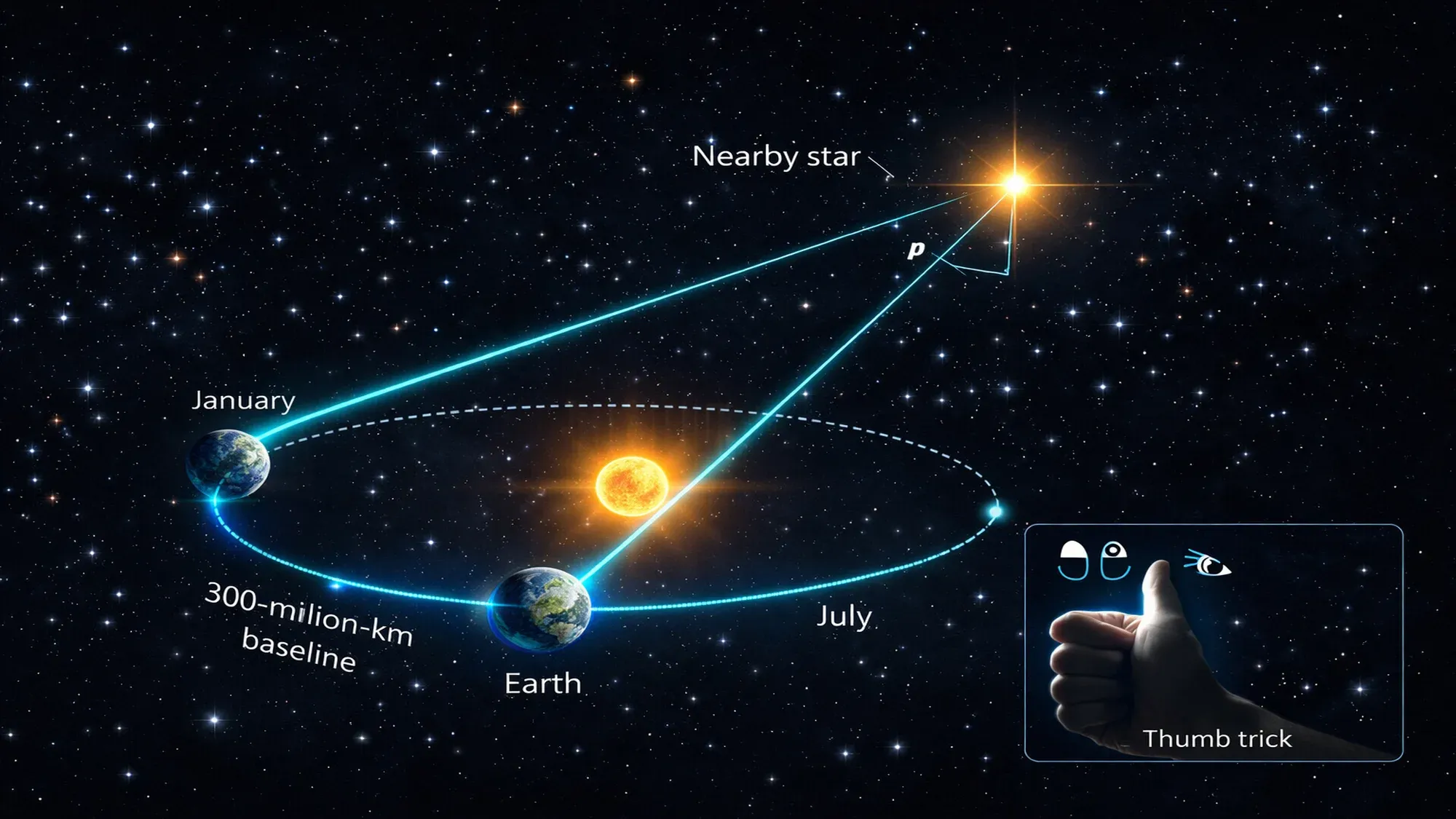
Here's the trick: instead of switching eyes, astronomers switch Earths.
Not metaphorically. The Earth orbits the Sun, which means that every six months we're on the opposite side of a 300-million-kilometre baseline. Photograph a star in January, photograph it again in July, and measure how much it appears to shift against the backdrop of more distant stars.
The shift is tiny. Laughably tiny. The nearest star to our Sun — Proxima Centauri, 4.24 light-years away — shifts by 0.77 arcseconds. For context, one arcsecond is 1/3600th of a degree. It's the angle subtended by a €1 coin viewed from five kilometres away.
And yet, this works. Friedrich Bessel first pulled it off in 1838, measuring the distance to the star 61 Cygni. He spent over a year at his telescope, meticulously recording positions night after night, doing the trigonometry by hand, and probably questioning every life choice that had led him to this particular flavour of obsessive precision.
The unit born from this method is the parsec — the distance at which a star would show a parallax of exactly one arcsecond. One parsec equals 3.26 light-years. It's the astronomer's preferred unit because it falls directly out of the math, no conversion needed.
(Yes, Han Solo’s “less than twelve parsecs” Kessel Run line is a distance, not a time. Astronomers have never forgiven George Lucas. Some wounds don't heal.)
📊 Parallax by the Numbers
| What | Value |
|---|---|
| Baseline | ~300 million km (Earth's orbit diameter) |
| Range | Up to ~30,000 light-years (with Gaia satellite) |
| Accuracy | ±0.00002 arcseconds (Gaia DR3) |
| First used | 1838 (Friedrich Bessel, 61 Cygni) |
| Best for | Our stellar neighbourhood |
The European Space Agency's Gaia mission, launched in 2013, has measured precise parallaxes for nearly two billion stars. Two billion. Bessel measured one star and it took him a year. Gaia does a billion and still has time to make the rest of us feel inadequate.
But here's the problem: parallax works only for relatively nearby stars. Beyond a few tens of thousands of light-years, the angle becomes so small that even Gaia can't measure it. The thumb trick runs out of reach.
We need a longer arm. Or a completely different trick.
🕯️ Rung Two: The Cosmic Candle (Cepheid Variables)
If you can't measure the angle, measure the brightness.
Imagine you're standing in a dark field and you see a light. If you know the light is a 100-watt bulb, and you can measure how bright it appears to you, you can calculate how far away it is. Closer bulbs appear brighter. Farther bulbs appear dimmer. Inverse square law. The math is clean, the concept is elegant, and the only problem is that the universe did not label its light bulbs.
Or so everyone thought until Henrietta Swan Leavitt proved them wrong.
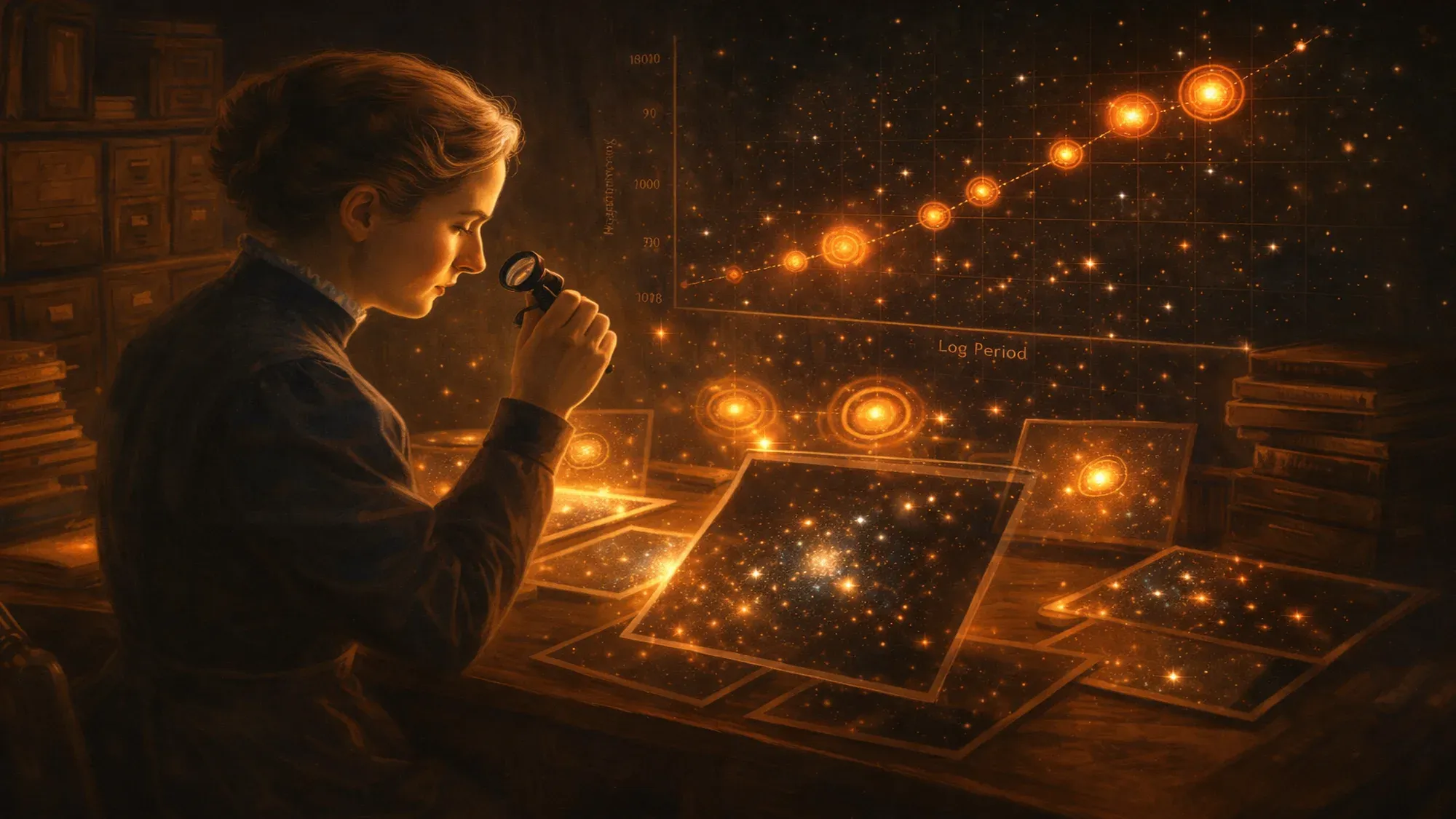
Leavitt was a “computer” at Harvard College Observatory — and by “computer” I mean a woman hired to do meticulous mathematical work for wages that would make a modern unpaid intern wince. The year was 1908. She was cataloguing variable stars in the Small Magellanic Cloud — stars that rhythmically brighten and dim over days or weeks — when she noticed something extraordinary:
The brighter ones pulsed slower.
Not randomly. Not approximately. There was a precise mathematical relationship between a Cepheid variable star's pulsation period and its true luminosity. Measure how fast it blinks, and you know how bright it actually is. Compare that to how bright it appears, and you get the distance.
She had found the universe's labelled light bulb. A standard candle.
The implications were staggering. Cepheids are visible in other galaxies. Which meant, for the first time, astronomers could measure distances outside our own galaxy. Edwin Hubble used Leavitt's method in 1924 to prove that the Andromeda “nebula” was not a gas cloud within the Milky Way but an entirely separate galaxy, millions of light-years away.
This settled the so-called Great Debate in astronomy — whether the Milky Way was the entire universe or merely one galaxy among many. Leavitt's blinking stars answered a question about the size of reality itself.
(Leavitt was never nominated for a Nobel Prize during her lifetime. She died of cancer in 1921. After her death, a Swedish mathematician tried to nominate her, only to learn the Nobel Committee's policy: no posthumous awards. The universe gave her the discovery that reshaped cosmology. The world gave her a salary that would barely cover rent.)
🔬 How It Actually Works
A Cepheid variable star physically expands and contracts. As it swells, it cools and dims. As it contracts, it heats and brightens. The period of this pulsation — anywhere from 1 to 100 days — is directly related to the star's intrinsic luminosity.
So when I spot a Cepheid in a distant galaxy and measure its period at, say, 30 days, I look up the corresponding absolute brightness on Leavitt's period-luminosity curve, compare it to how bright it appears from Earth, and the difference gives me the distance. Same principle as the light bulb in the dark field — except the bulb is a star, and the dark field is the universe.
📊 Cepheids by the Numbers
| What | Value |
|---|---|
| Range | Up to ~100 million light-years |
| Period | 1–100 days |
| Discovered by | Henrietta Swan Leavitt, 1908 (published 1912) |
| Famous use | Hubble proving Andromeda is a galaxy (1924) |
| Calibrated by | Parallax measurements of nearby Cepheids |
The catch: Cepheids need to be individually resolvable — you have to see the single star pulsing. Beyond about 100 million light-years, even the most luminous Cepheids blur into the general glow of their host galaxy. The candle, however bright, eventually drowns in the crowd.
So what do you do when candles aren't enough? You look for something that doesn't just shine — it detonates.
💥 Rung Three: The Thermonuclear Yardstick (Type Ia Supernovae)
When candles aren't bright enough, use explosions.
A Type Ia supernova is not your ordinary stellar explosion. It's a very specific kind of cosmic detonation, and its specificity is what makes it useful.
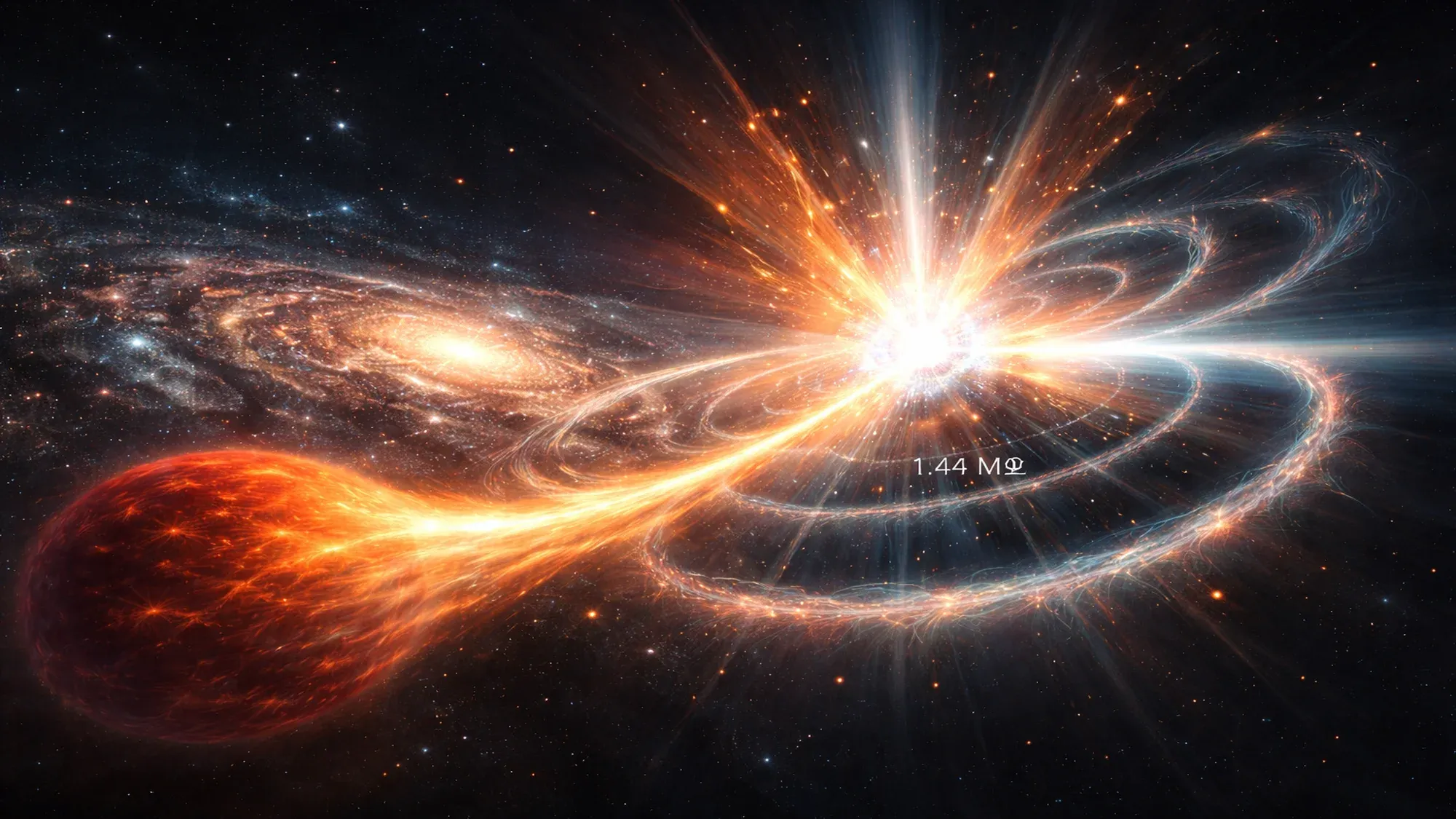
Here's the setup: a white dwarf — the dense, burnt-out core of a dead star — sits in a binary system, slowly stealing matter from a companion star. Hydrogen and helium rain down onto the white dwarf's surface, accumulating, compressing. The white dwarf grows heavier. And heavier.
Until it hits 1.44 solar masses. The Chandrasekhar limit — named after Subrahmanyan Chandrasekhar, who calculated it in 1930 at the age of 19, presumably while the rest of us at 19 were figuring out how to do laundry.
At this mass, electron degeneracy pressure — the quantum mechanical force holding the star up — can no longer support the weight. Carbon and oxygen in the core ignite in a runaway thermonuclear explosion. The entire white dwarf detonates. Not collapses. Detonates. In seconds, it releases more energy than our Sun will produce in ten billion years of steady burning.
And here's the beautiful part: because the trigger is always the same mass limit, the explosion is always roughly the same brightness. Every Type Ia supernova is a standard bomb.
(Okay, they're not perfectly identical. Astronomers use the shape of the light curve — how quickly the supernova fades — to calibrate each one. It's called the Phillips relationship, and it gets the precision down to about 7%. Which, in a universe measured in billions of light-years, is remarkably good.)
At peak brightness, a Type Ia supernova can outshine its entire host galaxy. Billions of stars, and this one explosion is brighter than all of them combined. You can see it from very far away.
📊 Type Ia Supernovae by the Numbers
| What | Value |
|---|---|
| Range | Billions of light-years |
| Trigger | White dwarf exceeds 1.44 M☉ |
| Peak brightness | ~5 billion times our Sun |
| Precision | ~7% distance accuracy |
| Famous for | Proving the universe's expansion is accelerating (1998) |
In 1998, two independent teams used Type Ia supernovae to make one of the most shocking discoveries in the history of science: the expansion of the universe is not slowing down. It's speeding up. Something — now called dark energy — is pushing everything apart faster and faster.
This won Saul Perlmutter, Brian Schmidt, and Adam Riess the 2011 Nobel Prize in Physics. The discovery that the universe is accelerating toward a cold, dark, lonely future. Congratulations, everyone.
(The committee did not mention whether they considered this “good news.”)
🔴 Rung Four: The Stretchy Light (Redshift & Hubble's Law)
Beyond the reach of individual explosions, we arrive at the final great trick. And this one doesn't measure an object at all. It measures the space between us.
In 1929, Edwin Hubble (yes, him again — the man collected landmark discoveries the way some people collect stamps) combined his own galaxy distance measurements with velocity data from Vesto Slipher and noticed something astonishing:
Almost every galaxy is moving away from us. And the farther away it is, the faster it's receding.
This wasn't because we're at the centre of some cosmic explosion. It's because space itself is expanding. Every point in the universe is moving away from every other point, like dots on a balloon being inflated. The more space between two dots, the faster they separate.
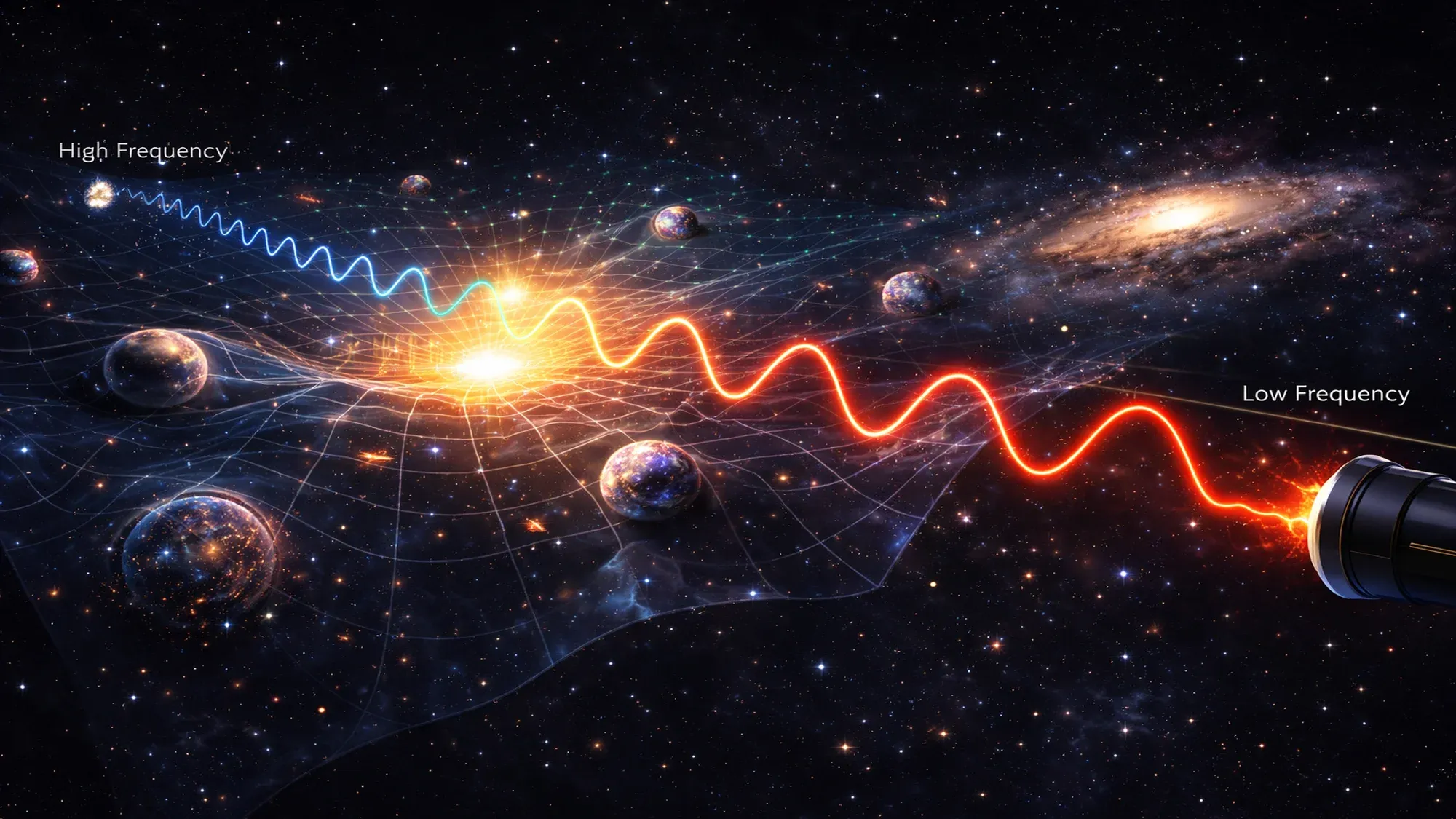
And here's the clever part: as a galaxy recedes, the light it emits gets stretched — its wavelengths elongate, shifting toward the red end of the spectrum. This is redshift. The greater the redshift, the faster the recession, and therefore the farther the galaxy. Measure the colour shift, and you get the speed. The speed gives you the distance, through a beautifully simple relationship:
v = H₀ × d
Velocity equals the Hubble constant times distance. That's it. One equation, and suddenly the entire observable universe has a tape measure.
(When Einstein first learned that the universe was expanding, he reportedly called his assumption of a static universe his “greatest mistake.” Most of us have made mistakes, but few of us have made mistakes about the fundamental nature of reality.)
📊 Redshift by the Numbers
| What | Value |
|---|---|
| Range | The observable universe (~46 billion light-years in every direction) |
| Key relationship | v = H₀ × d |
| Hubble constant (H₀) | ~70 km/s/Mpc (still debated!) |
| First measured | 1929 (Hubble, building on Slipher and Leavitt) |
| Most distant object | Galaxies at z ≈ 14+ (JWST era — light from ~290 million years after the Big Bang) |
The Hubble constant — the rate of expansion — is one of the most hotly contested numbers in all of physics. Different measurement methods give slightly different values, and nobody can agree on why. It's called the Hubble Tension, and it has been the subject of more heated conference debates than any reasonable number should warrant. Two decades in, and it refuses to be solved.
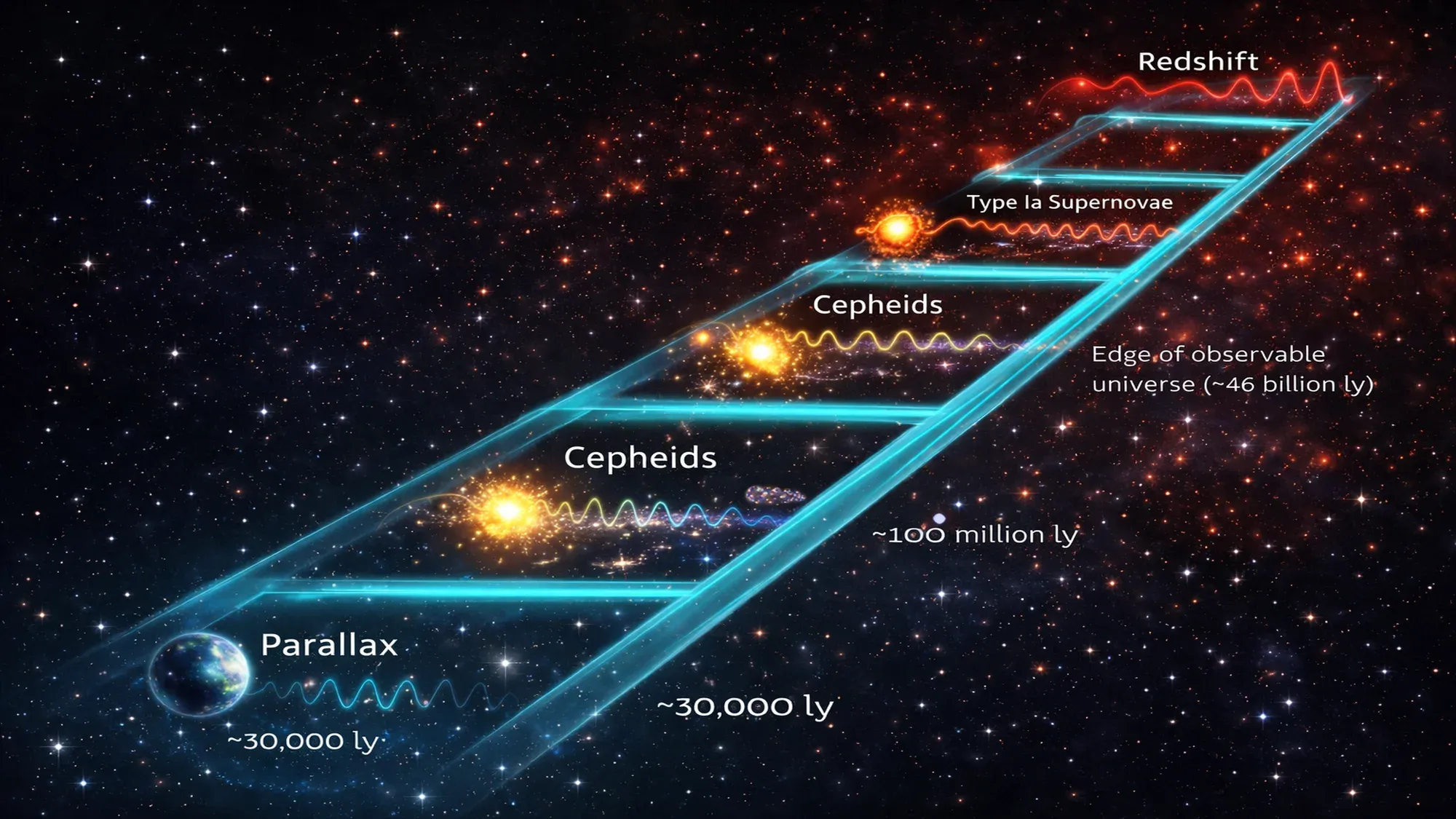
🪜 The Ladder: How It All Connects
Here's the part that makes the whole thing either elegant or terrifying, depending on your relationship with uncertainty.
Each rung depends on the one below it. Cepheids are calibrated by parallax. Supernovae are calibrated by Cepheids. Redshift is calibrated by supernovae. If the first rung is wrong — if our parallax measurements are off — then every distance above it inherits that error. The entire ladder wobbles.
This is why the Gaia mission matters so much. By dramatically improving the precision of parallax — the foundation — it tightens every measurement built on top of it. It's like fixing the ground floor of a skyscraper. The penthouse doesn't care how beautiful it is if the lobby is tilting.
🔭 Epilogue: The Beautiful Absurdity of It All
I think about Bessel sometimes. Standing at his telescope in Königsberg, night after frozen night, squinting at 61 Cygni through 1838's best optics — which, by modern standards, were barely better than a good pair of binoculars. He didn't know what a parsec was. The word wouldn't exist for decades. He just knew that if he watched carefully enough, and measured precisely enough, the universe would give up one small secret.
He was right.
And Henrietta Leavitt, underpaid and uncredited, staring at photographic plates until the pattern clicked. She never saw the inside of the galaxies her discovery would reveal. She never held a Nobel Prize. She held a magnifying glass and a salary that wouldn't cover a modern phone bill. But she found the rhythm in the blinking, and that rhythm rewrote the map of everything.
Each rung of this ladder is a confession. Parallax confesses that we can't leave our orbit. Cepheids confess that we can't get close enough to measure directly. Supernovae confess that we can't even see individual stars anymore. Redshift confesses that the universe is expanding faster than we can chase it.
And each rung is also a refusal. A refusal to accept the limitation. You won't give me a ruler? Fine. I'll use a thumb. A blinking star. A thermonuclear explosion. I'll measure the stretch of light itself if I have to.
Nobody who placed a rung lived to see the full ladder. Bessel didn't know about Cepheids. Leavitt didn't know about dark energy. Hubble didn't know the expansion was accelerating. They each solved the problem in front of them and trusted that someone, someday, would climb higher.
And here I am, writing about it — standing on centuries of stubbornness, staring at a universe that never once asked to be measured.
It didn't have to. We were going to measure it anyway.
“The nitrogen in our DNA, the calcium in our teeth, the iron in our blood, the carbon in our apple pies were made in the interiors of collapsing stars. We are made of starstuff. And we’ve spent four centuries trying to measure how far away the factory is.” — Carl Sagan (mostly), with a Codyssey edit

